Every week, event companies, promoters and facility developers ask us the same question: what does a portable basketball court actually cost in 2026? It is the right question to ask — and the hardest one to answer with a single number. "Portable basketball court cost" is not a catalogue figure. It is the sum of the floor system itself, international freight, installation labor, court markings, storage between events, and take-down — and each of those components moves depending on your court size, your material choice, and how often you assemble and dismantle the floor.
We are NBfloor (portablesportsfloor.com), a Chinese manufacturer of portable and fixed wooden sports flooring systems exporting to event organizers, rental companies and sports facility builders worldwide. We quote these projects every week, and we quote per project — never off a generic price list — because two courts of identical square meters can differ substantially in total project cost once freight lanes, installation schedules and usage cycles are factored in. What we can do honestly, in this guide, is show you exactly how the cost breaks down, which factors multiply, where buyers routinely under-budget, and how to get an accurate 2026 quote within 48 hours. Actual pricing always comes from a project quote; the numbers used below are clearly-labelled illustrative examples chosen to show the arithmetic.
1. What "Portable Basketball Court Cost" Actually Includes
The most common budgeting mistake we see is treating the floor price as the project price. In reality, a portable basketball court project has at least six cost components, and the floor system is usually only the largest — not the only one.
- The floor system itself. Panels, understructure, connectors, perimeter ramps and edge trims. This is priced per square meter and is the component most affected by your material choice (more on material classes in Section 4).
- International freight. Portable flooring ships in panels and crates. A full-size court is measured in cubic meters, not just square meters, so ocean freight cost depends heavily on packing density, destination port, and whether you ship FCL or LCL. Buyers comparing a Chinese manufacturer against a local distributor should compare landed cost, not ex-works price.
- Installation labor. One of the genuine advantages of a well-engineered portable system is that it needs no specialist flooring contractors. Our H500 Portable Assembled System, for example, installs a standard court in approximately 5 hours with a crew of 4–6 people using no permanent fixing — but that crew's time is still a real cost line in your event budget, and you should plan for a trained team rather than untrained temporary labor.
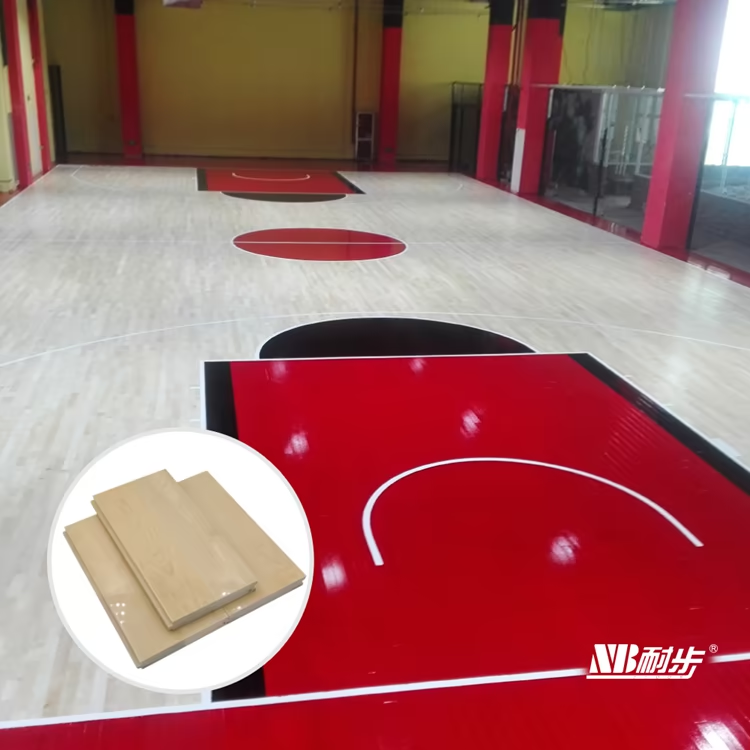
- Court markings and line work. Lines are not decoration; on a hardwood portable court they are applied to order at the factory. Custom line layouts, multi-sport configurations or sponsor-branded elements affect the quotation.
- Storage. A portable court that is not on the road needs a dry, level, climate-stable storage space. Panels and crates occupy real warehouse square meters, and in some markets that space costs more per year than buyers expect.
- Take-down, transport between venues and re-assembly. For a rental or touring floor, the install–dismantle–ship cycle repeats dozens of times over the floor's life. The system's design determines how expensive each cycle is; your logistics plan determines the rest.
When you compare quotations between suppliers, check that all six components are visible. A quote that looks dramatically cheaper is often quoting only component one. If you are early in your research, our overview of portable vs fixed sports flooring explains the structural differences that drive these cost categories.
2. The Worked Example: How Court Size Drives the Arithmetic
Before any pricing conversation, do this arithmetic yourself — it is the single most useful thing a buyer can bring to a quote request.
As an illustrative example: a standard full basketball court playing area is 28 m × 15 m = 420 m². Most projects also add a safety runoff zone around the court; a modest 1–2 meter runoff on each side can push the floored area toward 500–600 m² or more, and some buyers floor the entire venue footprint. The point is that "a basketball court" and "the area you actually floor" are rarely the same number, and the difference is pure budget.
Now watch how the factors multiply. Suppose a supplier quotes a system at some price per square meter — call it P. Your floor component is roughly P × 500 (not P × 420) once runoff is included. Freight scales with volume and lanes, not with your playing area. Installation labor scales with area and with how fast the system assembles — this is where the difference between a 5-hour system and a 2-day system becomes visible money, repeated at every event. Markings are largely a per-project fixed cost, so they weigh proportionally more on a small training court than on a full arena floor.
The practical takeaways for your 2026 budget worksheet:
- Fix the floored area, not just the playing area, before requesting quotes. Get it from your venue drawings if possible.
- Decide the number of install cycles per year. A floor used twice a year and a floor touring weekly are different purchasing decisions with different economics.
- Note your destination port and incoterms preference (CIF, DAP, etc.) so freight can be quoted like-for-like across suppliers.
If you send us these three data points through our contact page, you will have a structured quotation within 48 hours — and you will be able to compare it apples-to-apples against any other quote you hold.
3. Material Class vs Budget: PP Tiles, Portable Hardwood, Fixed Hardwood
The biggest single swing factor in any portable basketball court cost is the material class you choose. We will not invent exact market price tables here — prices move with timber markets, steel, freight rates and specification — but the cost logic between classes is stable and worth understanding before you compare quotes.
Modular PP (polypropylene) tiles sit at the lightest end. They are inexpensive to manufacture and ship, install very quickly, and tolerate outdoor and multi-purpose abuse. The trade-offs are playing performance — ball bounce, shock absorption, and the "plastic" feel underfoot — and a shorter premium-service life. For community events, futsal-style activations and budget-driven temporary installations they are a rational choice. We compare the two philosophies in detail in modular PP tiles vs hardwood.
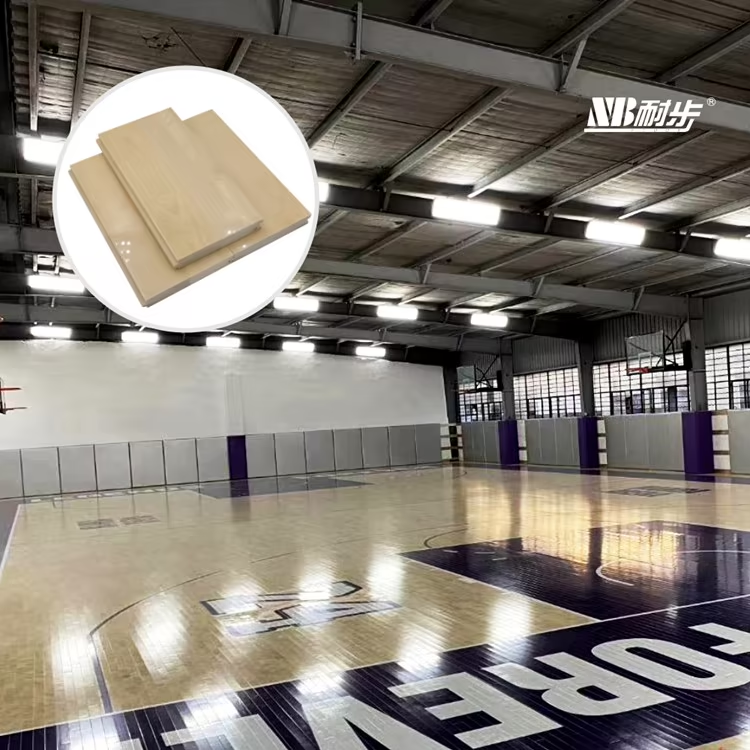
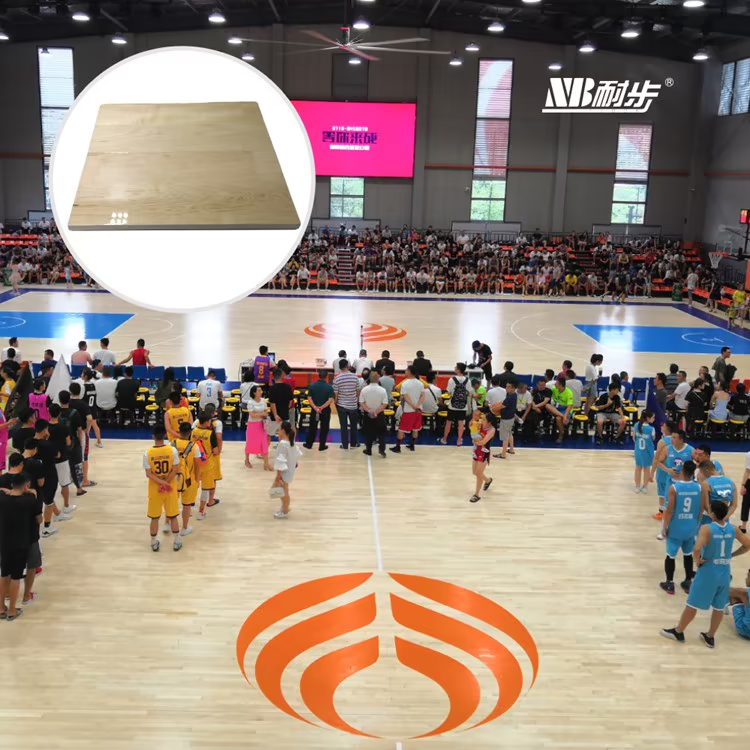
Portable hardwood systems occupy the professional middle. You get genuine wood playing characteristics — the ball response and underfoot feel that players and broadcasters associate with real basketball — combined with engineered portability: panels that connect without permanent fixing, cushion layers that travel with the floor, and repeatable assembly. Within this class there is still meaningful spread, driven mainly by the top-layer species and thickness. Our H500 Portable Assembled System uses a solid maple top layer at 20 mm over a larch LVL batten layer at 30 mm and an 18 mm rubber cushion, joined with snake-spring connectors — a build-up designed for competition-grade play. Our H600 Portable Birch System uses a 22 mm birch top layer on the same build-up concept, aimed at buyers running frequent assembly cycles and travelling courts, where durability through repeated handling matters as much as absolute elite-play feel. Birch and maple sit at different points on the cost curve, which is why we offer both: it lets rental companies match material to duty cycle instead of paying for performance their use case never exercises.
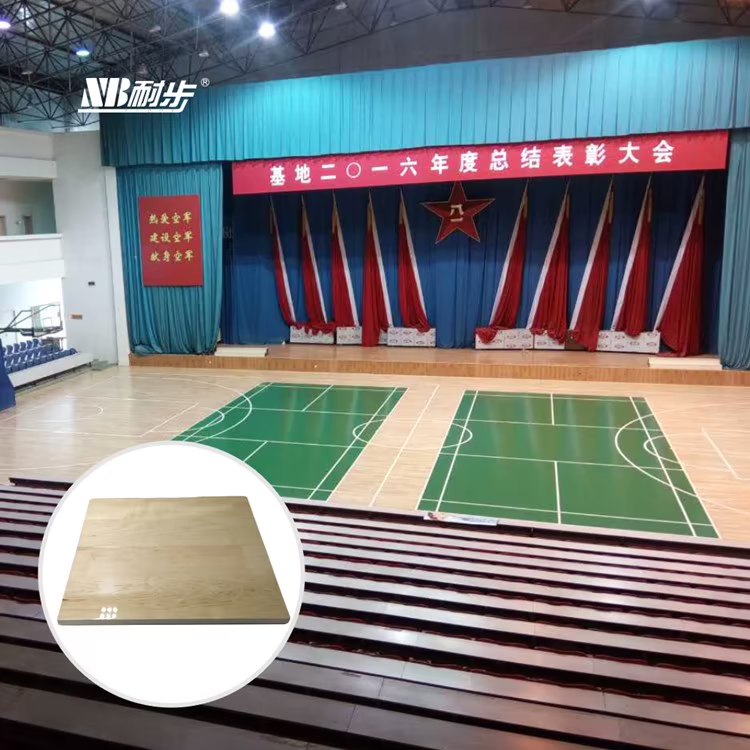
Fixed hardwood systems are the reference standard for permanent venues and, per square meter of system, typically sit above portable hardwood because of full-depth construction and installation requirements. If your venue is permanent, a fixed system such as our H3035, H3035K or H3035M deserves a parallel quotation even if your headline interest is portability — sometimes the honest answer is that you do not need portability at all, and a fixed floor is the better long-term economic choice.
One more honesty note: within each class, extremely low quotes usually mean something specific — thinner top layers, less cushion, weaker connectors, or no factory-applied lacquer. The lacquer matters more than buyers think: our H500 and H600 systems carry a 95° gloss lacquer finish, which protects the wood through assembly cycles and affects both lifespan and per-event refurbishment cost.
4. Cost Breakdown: The Components and What Drives Them
Use this table as a checklist when you review any 2026 quotation. The right-hand column is where most budget surprises live.
| Cost Component | What Drives It |
|---|---|
| Floor system (panels, battens, cushions, connectors) | Floored area in m²; top-layer species and thickness (maple vs birch); understructure build-up; factory lacquer; connector design |
| Court markings | Line layout complexity; multi-sport configurations; sponsor or branding elements; applied to order at the factory |
| Perimeter and safety items | Ramps, edge trims, runway extensions; whether the venue needs full-perimeter or partial coverage |
| International freight | Shipping volume in m³; packing density of the system; destination port; FCL vs LCL; incoterms; fuel and lane volatility in 2026 |
| Installation labor | Assembly speed of the system (hours per court); crew size required; number of install cycles per year; local wage levels |
| Storage between events | Crated volume; warehouse cost per m² in your market; climate control requirements for wood flooring |
| Import duties, taxes and clearance | Applicable HS classification and duty rate in your country; port handling; documentation quality from the supplier |
| Lifecycle and refurbishment | Assembly-cycle durability; ability to replace individual panels; re-lacquer interval; spare-parts availability |
5. Hidden Cost Factors Buyers Miss
After years of quoting export projects, these are the line items that most often appear after the contract rather than before it. None of them are exotic — they are just easy to forget at quotation stage.
- Customs duties, VAT/GST and clearance fees. Wooden sports flooring has its own HS classification, and duty treatment varies widely by destination. Ask any supplier to state the HS code they will declare under, and get a local customs broker's estimate before you sign. Vague documentation from a supplier converts directly into demurrage and delay costs.
- Spare panels and parts. A touring floor will lose panels — edges chip, forklifts meet ramps, crates get mislaid. Budgeting a small percentage of the court as spare inventory at the time of the original order is far cheaper than air-freighting a matching replacement later, especially with wood, where batch-to-batch color and grain shift over time.
- Substrate and venue preparation. "Portable" does not mean "works on anything." A portable hardwood system still needs a level, dry, load-bearing base. Concrete slabs, arena floors and even outdoor asphalt vary, and leveling work, moisture barriers or protective underlays at difficult venues are real costs that no flooring quote can absorb for you. Walk your worst venue, not your best one, before finalizing the budget.
- Crew training. The fastest systems still reward a trained crew. The difference between a team that has done it ten times and one doing it for the first time shows up in hours, which shows up in labor cost, which shows up in your event schedule. Factor a supervised first assembly into your plan, and keep the manufacturer's assembly documentation with the crates.
- Climate and acclimatization. Wood moves with humidity. Courts crossing climates — a floor shipping from a humid coastal region to a dry inland venue — benefit from acclimatization time before assembly, which affects your event timeline even when it does not appear on any invoice.
- Insurance and handling. A competition-grade portable court is a significant asset. Transit insurance, event insurance riders and proper handling equipment (pallet jacks, transport carts) all belong on the ownership-cost list.
6. Renting vs Buying a Portable Basketball Court
Not every buyer should buy, and the honest math is simpler than most rental-vs-purchase debates make it sound.
Renting makes sense when your need is occasional and unpredictable: one or two events a year, no storage space, no in-house crew, and a venue within reach of a rental operator. You pay per event and somebody else carries the storage, maintenance and obsolescence. The break-even logic: multiply the rental quote per event by your realistic number of events per year, add your own labor and logistics for both scenarios, and compare against the amortized purchase cost. For many buyers the crossover arrives faster than expected — commonly within a few seasons of regular use — because rental pricing must cover the rental company's own freight, storage, crew and margin every single time.
Buying makes sense when any of these are true: your event calendar is regular and growing; you operate in a region where rental supply is thin or absent; you want control over the playing standard your brand is associated with; or you intend to sub-rent the floor between your own events (a genuinely common model among event companies, and one that can materially change the investment case). Buying also lets you specify the floor to your duty cycle — which is exactly why the maple-topped H500 and the birch-topped H600 exist as separate systems rather than one product with a price list.
A middle path worth naming: buying a smaller training or show court (for example, a half-court footprint) while renting full courts for your largest events. It keeps a physical demo asset for client meetings and sponsorship shoots at a fraction of a full-court budget, and it trains your crew on a system before the big deployments. Our guide on how to install, store and manage temporary sports flooring covers the operational side of ownership in detail.
7. How to Get an Accurate Portable Basketball Court Cost Quote in 2026
The speed and accuracy of your quotation depend almost entirely on what you put in the first message. As the manufacturer, we return structured quotations within 48 hours — but the 48-hour clock starts properly only when the key variables are on the table. Send us these, and you will get a quotable number instead of a range:
- Floored area in m² (with the runoff zone included), or venue dimensions and drawings if the area is not yet fixed.
- Use profile: how many events or assembly cycles per year, and whether the court is single-venue or travelling.
- Destination port or city and your preferred incoterms, so freight is quoted rather than guessed.
- Markings requirement: standard FIBA-style basketball lines, multi-sport lines, or custom branding.
- Timeline: when the floor must be on site, which determines production slotting and shipping mode.
Details matter at this stage, and sloppy specifications are the most common cause of quote–reality gaps. We wrote a whole guide on how to get an accurate sports floor quotation that walks through exactly which details to send and why. If you are still deciding between system types, our buyer's guide to choosing portable basketball flooring pairs well with this article. You can also browse all systems on our products page or read the rest of the blog.
A note on what a trustworthy quote looks like: it names the system and build-up (top layer species and thickness, batten layer, cushion), states the lacquer finish, specifies what is included in markings, separates or clearly states freight assumptions, and references actual compliance documentation. Our H500 system, for instance, is produced under an Approved Equipment Level 1 licence (WF-05-01) and the H600 under WF-05-02 — the kind of verifiable reference a serious quotation should carry, and the kind you should ask any supplier to show.
8. Frequently Asked Questions on Portable Basketball Court Cost
The short questions we field most often from B2B buyers, answered the way we would answer them on a call:
- What is a realistic budget range for a full-size portable hardwood court in 2026? We deliberately do not publish fixed price lists, because honest portable basketball court cost figures are project-specific: material class, floored area, freight lane and duty cycle move the total substantially. What we can tell you is how to bound it — fix your floored area, shortlist two material classes, and request project quotes against identical specifications so the comparison is real. Two structured 48-hour quotes will tell you more than any published table, including ours.
- Why is a portable hardwood system more expensive than PP tiles? Because you are buying wood, an engineered multi-layer understructure (battens and cushion), factory lacquer, and hardware engineered to survive dozens of assembly cycles without permanent fixing. PP tiles are lighter and simpler in every dimension — which is precisely why they cost less and perform differently. Neither is "better" in the abstract; they answer different duty cycles and budgets.
- How long does installation take, and what crew do I need? With a purpose-engineered system like the H500, a standard court assembles in approximately 5 hours with a crew of 4–6 people and no permanent fixing. Budget your first assembly with some margin for learning, then treat the steady-state figure as your planning number for every event after that.
- Can I get custom court markings and branding? Yes — markings are applied to order, including custom layouts and sponsor elements. Tell us the marking plan at quotation stage, not after production, because line work is planned into the panel layout and finishing schedule.
- How fast can I get a firm number? Send the five items in Section 7 through our contact page or WhatsApp and you will have a structured quotation within 48 hours, with freight stated rather than hidden.
9. The 2026 Buyer's Budget Checklist
Before you send any inquiry or compare any quotations, make sure your own worksheet covers: the true floored area including runoff; your annual number of assembly cycles; your material class decision informed by duty cycle rather than by headline price; landed-cost freight assumptions to your actual port; duties and clearance with the declared HS code; a trained-crew labor plan for install and take-down; storage space with climate conditions; spare panels ordered with the original production run; and lifecycle items such as re-lacquer intervals and panel replaceability. A buyer who arrives with this list filled in is, in our experience, the buyer who ends up with a floor that performs for a decade instead of a floor that was cheapest in the inbox.
Portable basketball court cost in 2026 is not a mystery — it is a structure. Understand the structure, send complete specifications, demand verifiable documentation, and compare quotes like-for-like. When you are ready, our team will return a project-specific quotation within 48 hours.
Planning a sports floor project? Send the court dimensions, sports and destination port — we reply with a specification and a price within 48 hours.
Request a Quote