1. Why the Modular Tiles vs Hardwood Sports Floor Question Matters for Budget Buyers
If you are an event company, a sports promoter, a facility manager, or a distributor sourcing flooring for resale, you have almost certainly faced the same decision: modular tiles vs hardwood sports floor — which one actually fits your budget and your use case? The question sounds simple, but the answer is genuinely nuanced. Search the market and you will find polypropylene tiles at a fraction of the price of a portable hardwood court, and you will also find premium hardwood systems that cost several times more per square metre. Both products sell well. Both have satisfied customers. And both can be the wrong choice if you buy them for the wrong reasons.
This article is written for buyers with low-to-mid budgets who need a temporary or portable playing surface. We will compare modular PP court tiles against traditional portable hardwood honestly — no exaggeration in either direction. Where PP tiles genuinely win, we will say so. Where a portable hardwood court justifies its premium, we will explain exactly what you are paying for. By the end, you should be able to match a flooring type to your events, your venues, and your budget with confidence rather than guesswork.
At NBfloor, we manufacture both fixed hardwood systems and portable hardwood systems — the H500 Portable Assembled System and the H600 Portable Birch System — so we understand the appeal of modular polypropylene tiles as well. We would rather help you choose correctly than sell you a product that disappoints you, because a disappointed buyer never places a reorder. If after reading you want numbers specific to your court size, request a quote — we return detailed quotations within 48 hours.
2. What Modular PP Court Tiles Actually Are
Modular PP tiles — often called PP court tiles, polypropylene tiles, or interlocking outdoor sport tiles — are injection-moulded plastic tiles, typically 25 to 30 centimetres square and 12 to 16 millimetres thick, that snap together like puzzle pieces. Most designs include an open lattice or perforated underside that provides a small amount of give and allows water to drain through. Installation requires no adhesives, no nails, and no tools beyond a rubber mallet, which is precisely why they have become so popular in the budget segment.
Their strengths are real and worth stating plainly:
- Low purchase price. Per square metre, PP tiles are among the cheapest sport surfaces available, often costing a quarter or less of a portable hardwood system.
- Very fast installation. A small crew can cover a tennis or basketball court in a few hours with no specialised training.
- Outdoor durability. Polypropylene is UV-stabilised and waterproof; rain drains straight through the surface. For outdoor multi-use courts, this is a genuine advantage no wood floor can match.
- Minimal maintenance. Sweep, hose down, done. No lacquer to maintain, no moisture sensitivity, no refinishing cycles.
- Easy storage and transport. Tiles stack flat in pallets or crates and tolerate rough handling.
For municipal outdoor courts, school playgrounds, futsal pitches, and promotional events where the surface is decorative and recreational rather than competitive, PP court tiles are often exactly the right answer. Anyone who tells you polypropylene tiles are never appropriate is overselling their own product.
But the same properties create the limitations that matter for indoor sport. A 13 mm plastic tile with an open lattice cannot replicate how a 20 mm solid hardwood board on an engineered cushion feels, performs, or protects an athlete. Whether those limitations matter depends on what you are hosting — which is what the rest of this article examines.
3. What a Portable Hardwood Court Actually Is
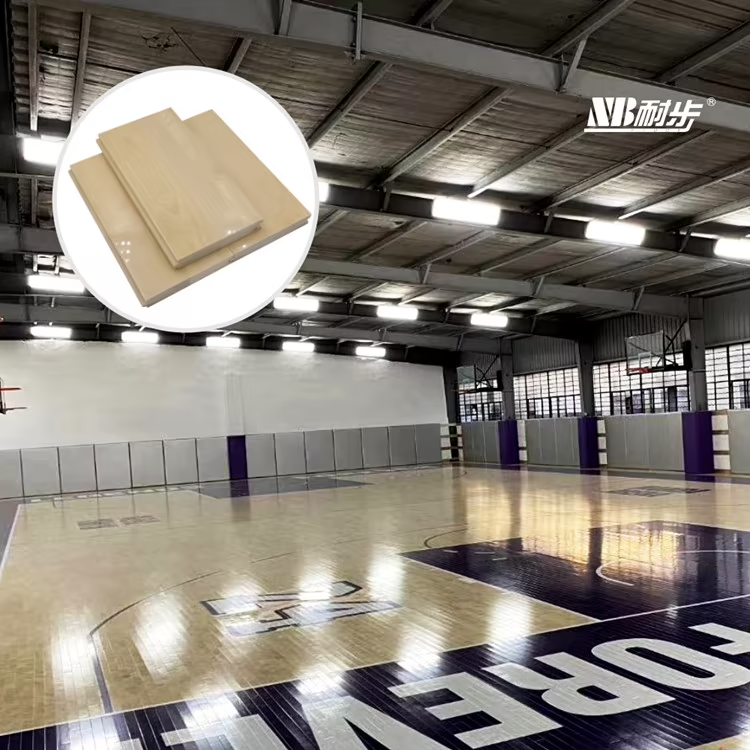
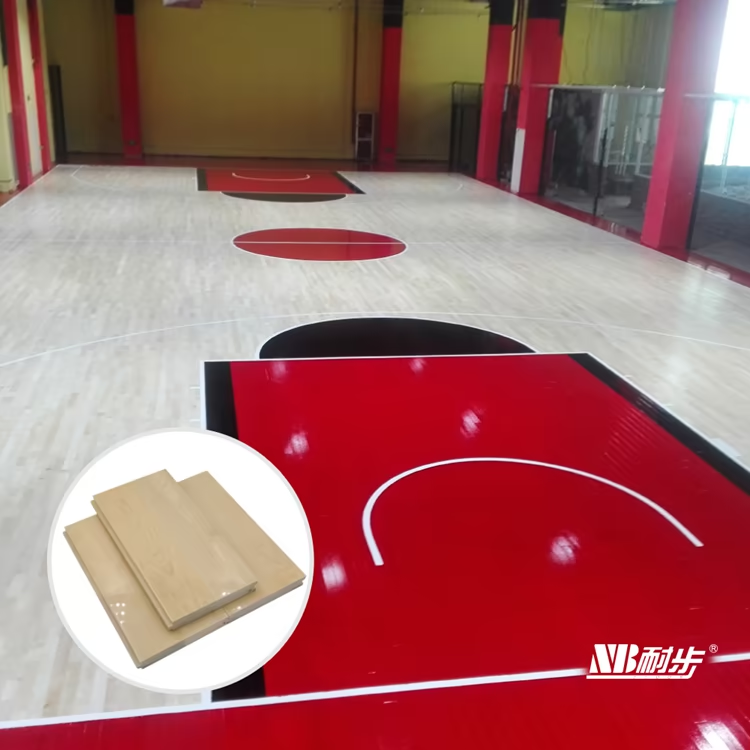
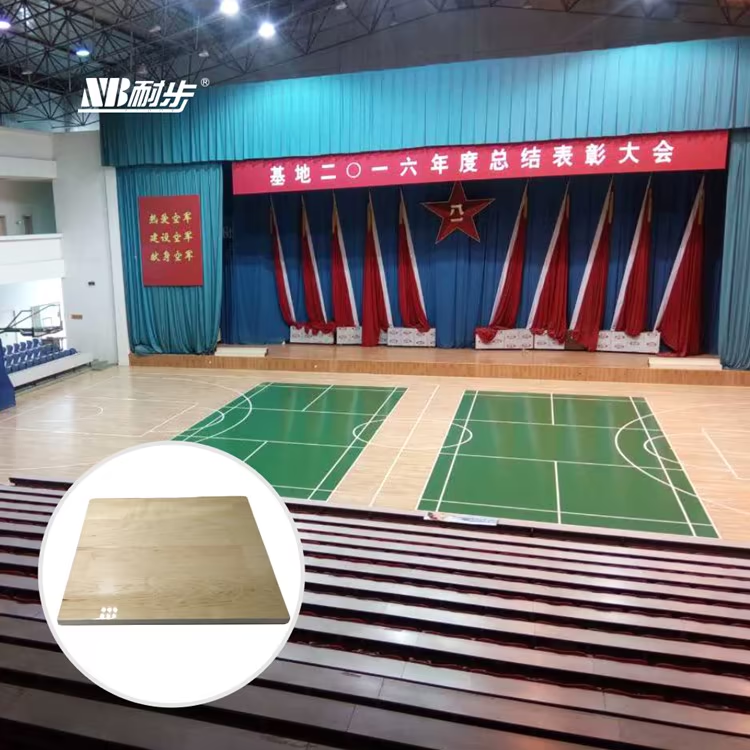
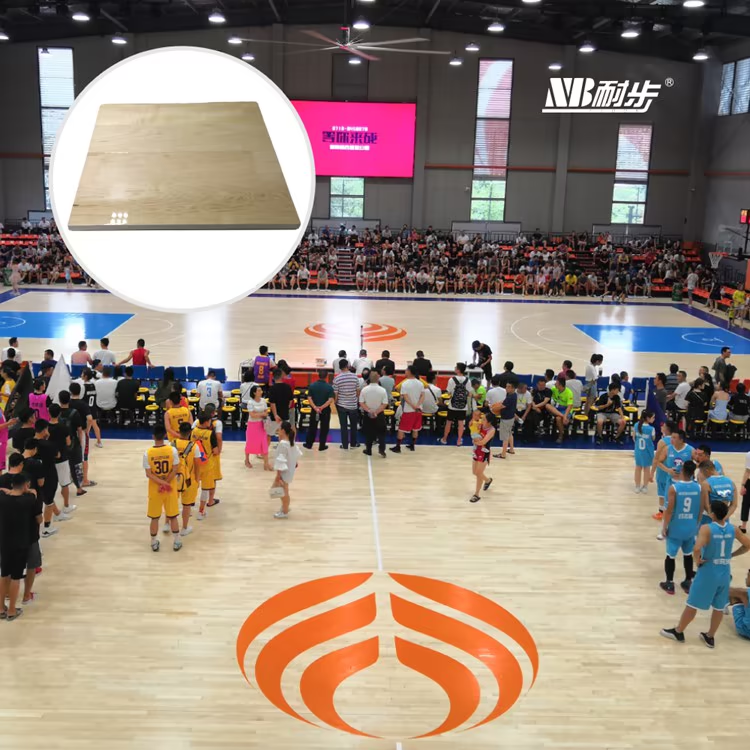
A portable hardwood court is a floating system of solid wood panels assembled over an engineered sub-structure, designed to be installed, used, dismantled, and reinstalled repeatedly without any permanent fixing to the substrate. It is the surface used at professional tournaments, televised events, and premium venues — for good reason.
Take our H500 Portable Assembled System as a concrete example. The build-up consists of a 20 mm solid maple top board, a 30 mm larch LVL batten layer, and an 18 mm rubber cushion underneath. The boards connect using snake-spring connectors, which lock the surface together laterally without screws, glue, or anchors — nothing penetrates the venue floor, so no permanent fixing is required and the host venue stays undamaged. A standard basketball court takes approximately 5 hours to assemble with a crew of 4 to 6 people. The surface is finished with a 95° high-gloss lacquer, the same look you see under arena lighting on broadcast courts. The H500 is an Approved Equipment Level 1 system under licence WF-05-01, a certification level relevant to buyers who must satisfy federations or venue operators.
For buyers who dismantle and reinstall constantly — travelling tournament courts, event venues that convert between sports and shows — we build the H600 Portable Birch System, which uses a 22 mm solid birch top board over the same batten-and-cushion structure. Birch is slightly more forgiving of the mechanical stress of frequent assembly and removal, and the H600 is certified under licence WF-05-02. Both systems, along with our fixed hardwood lines such as the H3035, H3035K, and H3035M, are listed on our products page.
The physics of the build-up explains the price difference. A layered structure of solid wood, LVL battens, and a rubber cushion absorbs impact energy instead of reflecting it back into the athlete's joints. Wood stores and returns energy with a spring-like quality that plastic cannot imitate, and a bonded lacquer finish gives the consistent grip and ball response that competitive play demands. You are not just buying a nicer-looking floor — you are buying engineered vertical deformation, area elasticity, and a surface that athletes and coaches recognise instantly as "real".
4. Head-to-Head: Modular PP Tiles vs Portable Hardwood
The table below summarises the practical differences that matter to B2B buyers. Note that "portable hardwood" here refers to a proper engineered floating system such as the H500/H600, not a cheap ply panel laid on a gym floor.
| Factor | Modular PP Tiles | Portable Hardwood (H500/H600) |
|---|---|---|
| Material | Injection-moulded polypropylene, 12–16 mm, perforated | 20 mm solid maple / 22 mm solid birch over LVL battens and rubber cushion |
| Feel underfoot | Hard, slightly flexible lattice; noticeable "plastic" sensation | Solid wood over cushioned structure; forgiving, natural feel athletes expect |
| Ball bounce | Acceptable for recreation; inconsistent on worn or warped tiles | Consistent, predictable rebound — matches competition requirements |
| Shock absorption | Minimal; impact energy returns largely to knees and ankles | High; rubber cushion layer absorbs impact, reducing fatigue and injury risk |
| Install speed (full court) | Fastest — a few hours, unskilled labour | ≈5 hours for a basketball court with a trained crew of 4–6 (H500) |
| Weight & freight | Light; stacks flat; low shipping cost | Heavier; palletised; higher freight but still container-friendly |
| Appearance | Functional, sporty colours; visibly plastic up close | 95° high-gloss lacquered hardwood; broadcast-quality, premium look |
| Durability outdoors | Excellent — waterproof, UV-stable, drains freely | Indoor use only; moisture and weather will damage wood |
| Lifespan & upkeep | 5–10 years typical; fade and surface wear; no maintenance routine | 20+ years with basic care; periodic lacquer maintenance |
| Indicative budget level | Low — lowest cost per m² in the market | Mid-to-high — several times PP tile pricing, amortised over far longer life |
5. Where PP Court Tiles Are Genuinely the Right Choice
To keep this comparison honest, let us be explicit about when polypropylene tiles outperform hardwood on value — because there are several such cases, and buying hardwood for these scenarios would simply waste money.
- Outdoor courts. If your surface lives outside — a community basketball half-court, a school playground, an outdoor futsal pitch — PP tiles are effectively the only sensible portable option. Wood and weather do not mix, full stop.
- Truly tight budgets with recreational use. If the brief is "something playable, as cheap as possible", and users are children or casual players, PP court tiles deliver a functional surface at a price hardwood cannot approach.
- Frequent informal reconfiguration. For pop-up activations, marketing events, and festival zones where the floor is a colourful prop rather than a competition surface, tiles are faster and cheaper to deploy and easier to replace if individual pieces are lost or damaged.
- Distributor entry-level catalogues. If you are a distributor building a product range for price-sensitive local markets, PP tiles fill the low end of the range and rarely generate complaints at that price point.
In these cases the "modular tiles vs hardwood sports floor" debate is over before it starts: the hardwood premium buys nothing the user will notice. If your projects look like the list above, you can stop reading here with a clear conscience — PP tiles are your answer. Our related article on portable basketball court cost in 2026 breaks down the full cost picture across flooring types if you want the numbers side of this decision.
6. Where a Portable Hardwood Court Is Worth the Premium
Now the other side of the ledger. The moment any of the following conditions apply, the economics shift decisively toward hardwood — and buyers who ignored these factors are the ones who end up replacing their floor within two years.
- Competitive or televised play. Athletes competing seriously can feel the difference immediately. On thin plastic, joints tire faster, landing feels harsh, and hard pivots strain knees and ankles. Federations and professional clubs increasingly specify wood or certified equivalents. If your event carries a federation name or a broadcast camera, polypropylene tiles are a reputational risk.
- Long daily duty cycles. A floor used 6–10 hours a day, week after week, chews through plastic tiles — surface scratching, gloss loss, tile warping at hot spots. A 20 mm solid maple top over an engineered cushion is built for exactly this punishment.
- Venue image and sponsorship value. A 95° high-gloss lacquered hardwood court photographs beautifully, elevates ticket perception, and looks right under LED arena lighting and on camera. Sponsors paying for court-side branding are effectively paying for the premium look; a scuffed plastic surface undercuts that investment.
- Total cost over time. This is the argument budget buyers most often miss. PP tiles may need replacement within 5–10 years under commercial use; a maintained hardwood system serves for 20 years or more. Amortised per year of service, hardwood's premium shrinks dramatically — sometimes to parity.
- Repeat deployment at changing venues. A system like the H600, engineered for frequent assembly and removal with its snake-spring connectors and no permanent fixing, survives venue changes that would crack or loosen interlocking plastic.
The practical rule of thumb: the moment your flooring decision affects athlete safety, event reputation, or multi-year asset value, the cheapest option stops being the cheapest option. For a deeper treatment of the temporary-vs-permanent trade-off, see our comparison of portable vs fixed sports flooring.
7. Total Cost of Ownership: Looking Past the Price Tag
Budget-conscious buyers think in purchase orders; experienced buyers think in cost per event-year. Let us walk through the line items that actually determine which floor is cheaper over its life.
Acquisition and freight. PP tiles win on both counts — lighter, cheaper, easier to ship. This is the one category where hardwood never catches up, and it is why PP tiles dominate the low end.
Labour over repeated installations. Here the picture inverts. PP tiles are quick per installation, but they are also fragile in transit handling: a crew dragging crates across a loading dock chips edges and warps tiles, and replacement pieces must be bought periodically. A hardwood system like the H500 with its snake-spring connectors and rigid palletised panels tolerates hundreds of assembly cycles with near-zero attrition. At, say, 30 events per year, tile attrition becomes a real annual line item that never appears in the original quotation.
Maintenance. PP tiles need almost nothing — a genuine advantage. Hardwood needs routine dry mopping, moisture control, and occasional lacquer care, which our guide to maintaining a wooden sports floor covers in practical detail. But maintenance cost is modest and predictable, and in exchange the floor's playing characteristics stay constant for decades.
Replacement and resale. Worn PP tiles have essentially zero resale value and disposal cost. A well-kept hardwood system retains real value and can be re-lacquered and re-sanded rather than replaced. Distributors should note that hardwood systems also command higher resale prices in the secondary market, which partially offsets the initial premium.
Reputation risk. The hardest cost to quantify and the easiest to underestimate: one injury attributed to an unyielding surface, or one sponsor's social post showing a "cheap-looking" court, can cost more than the entire flooring premium. For event companies whose revenue depends on repeat bookings, this line item alone often decides the modular tiles vs hardwood sports floor question.
8. Matching the Floor to Your Business: Four Common Buyer Profiles
To make this decision concrete, here is how the choice typically resolves for the four buyer types reading this article.
- Event companies running short activations (1–7 days, general public). PP tiles frequently suffice. The surface serves for a weekend, athletes are recreational, and the budget favours plastic. If the activation includes actual games with competitive players or media coverage, step up to portable hardwood for the main court and keep tiles for surrounding zones.
- Sports promoters hosting tournaments or showcase games. Portable hardwood, without hesitation. Certified equipment matters to federations (note the H500's Approved Equipment Level 1 status, licence WF-05-01), athletes expect wood, and broadcast footage is an asset you reuse for years. The premium is a marketing cost as much as a flooring cost. Our guide to choosing portable basketball flooring walks through this evaluation in detail.
- Facility managers of multi-purpose indoor halls. If the hall converts between sports, concerts, and exhibitions, a floating hardwood system with no permanent fixing protects the base floor and delivers sport-grade performance whenever the floor is configured for play. Installation logistics matter here — our article on installing and storing temporary sports flooring covers crew planning, storage, and re-installation practice.
- Distributors and resellers. Consider carrying both ends. PP tiles serve your price-driven customers; a branded portable hardwood line serves your quality-driven ones and carries better margins per project. Many distributors find hardwood customers become the loyal, repeat-purchase accounts.
One warning applies to everyone: do not buy on specification sheets alone. Request a sample or visit a reference installation. The difference between a 13 mm plastic tile and a 20 mm maple board on rubber cushioning is felt in thirty seconds of jumping and pivoting, and no table or article — including this one — substitutes for that experience.
9. How to Decide — and How to Get Accurate Numbers Fast
Strip away the marketing and the decision framework is short. Answer these questions in order:
- Is the floor indoors or outdoors? Outdoors → PP tiles. Indoors → continue.
- Is play recreational or competitive? Recreational-only, occasional → PP tiles can work. Competitive, frequent, or long-duration → portable hardwood.
- Does the event's image affect your revenue? If yes → hardwood's appearance and broadcast quality pay for themselves.
- How many assembly cycles per year, and over how many years? High cycles over many years → the hardwood system's durability and resale value close the cost gap.
- What is your true budget — this purchase, or cost per event-year? If the latter, run the totals before defaulting to the cheapest quote.
When you reach the numbers stage, precision matters. Flooring quotations vary widely depending on court size, configuration, shipping terms, and marking requirements, and a vague enquiry produces a vague quote. We have written a dedicated guide to getting an accurate sports floor quotation that tells you exactly what information to prepare.
If a portable hardwood system looks like the right fit, NBfloor makes the next step easy. Tell us your court dimensions, event frequency, and destination port, and we will return a complete quotation within 48 hours — including the H500 and H600 options, freight estimates, and any court markings you need, which are applied to order. You can reach us through the contact page or directly via WhatsApp. Whether your final choice is a container of PP court tiles or a containerised portable hardwood court, our goal is the same: a floor that fits your budget, performs at your events, and makes you look good for having chosen it.
Planning a sports floor project? Send the court dimensions, sports and destination port — we reply with a specification and a price within 48 hours.
Request a Quote