Choosing a portable basketball floor is one of the highest-stakes purchases a gym operator or event company will make. The floor is the largest surface your athletes, students, or paying customers will ever touch, and unlike a fixed floor, a portable system has to survive being taken apart, transported, and rebuilt dozens or hundreds of times. Get the specification wrong and you pay for it twice: once in poor playing conditions, and again in premature replacement.
This portable basketball flooring guide is written for professional buyers — sports facility managers, event production companies, school procurement teams, and distributors — who need to compare systems on facts rather than brochure language. It covers the four system types you will encounter, the technical factors that affect play and safety, the logistics of installation and storage, and the lifecycle math that separates a cheap floor from an economical one.
1. Why the Floor Choice Affects Play and Safety
Basketball is a high-impact sport played on a surface that must absorb landing energy, return it predictably, and provide consistent traction in every direction. When those properties drift, performance degrades first, injuries follow, and your venue's reputation comes last.
The measurable properties are well established in sports construction. Shock absorption describes how much landing force the structure dissipates instead of returning to the joints. Ball bounce measures how consistently a basketball rebounds compared with a rigid reference — players notice inconsistency long before they can explain it. Surface friction determines grip: enough to cut and stop hard, not so much that feet stick and ankles roll. For a portable floor there is an extra layer fixed floors never face: every one of these properties must be reproduced at every installation, on substrates you do not control, by crews that may not be your own. A fixed floor is engineered once; a portable floor is re-engineered every time it is set down, which is why connection design and build-up structure matter more than any single material spec.
Safety documentation is also a commercial issue, and we return to it in the lifecycle section: schools and federations increasingly ask for proof of sports performance and equipment approval, and a floor that cannot support its claims with a licence number will lose tenders a properly documented system would win.
2. The Four System Types Buyers Encounter
When you request quotes for a temporary basketball court, offers will typically be built on one of four technologies. Each has a genuine application; the errors happen when a system is pushed into a job it was never designed for.
- Modular portable hardwood assembly systems. Panels of solid wood — typically maple or birch 20–22 mm thick — on engineered battens and a cushion layer, joined with mechanical connectors, laid over a flat substrate without permanent fixing. This is the category professional and semi-professional basketball demands: genuine hardwood feel, real force reduction, and long service life across many assembly cycles, at the price of higher weight and skilled labor.
- Polypropylene (PP) interlocking tiles. Molded plastic tiles that snap together by hand. They install in hours with unskilled labor, tolerate outdoor and damp conditions, and cost a fraction of hardwood. The trade-offs are equally real: a harder feel underfoot, lower shock absorption, and a "training court" identity rather than a game court. For outdoor courts and school yards they are sensible; for hosted basketball events, most organizers find they compromise the athlete experience. We compare them in depth in our article on modular PP tiles versus hardwood.
- Roll-out vinyl surfaces. Fast to deploy for low-impact use — trade shows, dance, casual play — and light to transport. But bare vinyl provides minimal force reduction and no supported deflection, so it is not a substitute for an engineered structure where real basketball happens.
- Fixed systems with portable use. A venue installs a permanent floor and reserves an area, or overlays sections, for occasional reconfiguration. Cheaper than owning two floors, but it gives up true portability.
A practical rule: if basketball is the primary sport and the floor will be assembled and removed repeatedly, modular hardwood is the defensible choice. If you are unsure whether you need mobility at all, see our guide on portable versus fixed sports flooring.
3. Inside a Modular Hardwood System: What Each Layer Does
Not all "portable hardwood" panels are equal, and the differences live beneath the top board. Take our H500 portable assembled flooring system as a concrete example. The top board is 20 mm solid maple — the traditional basketball choice for hardness, fine grain, and uniform appearance under gym lighting. Beneath it sits a 30 mm larch LVL batten layer; LVL matters because it is dimensionally stable, so the floor stays flat through years of assembly cycles where solid-sawn battens would twist. The lowest layer is an 18 mm rubber cushion that provides shock absorption and compensates for minor substrate irregularities. Panels are joined with snake-spring connectors that pull the surface into one continuous plane and spread loads across joints instead of concentrating them at panel edges.
- Top board thickness and species govern durability, refinishing potential, ball response, and appearance.
- The batten layer creates the resilient cavity that gives the floor its deflection characteristics and spreads point loads; its stability determines whether the surface stays flat after its fiftieth assembly.
- The cushion layer delivers much of the shock absorption and is your buffer against real-world substrates that are never quite flat.
- The connection hardware determines assembly speed, joint integrity, and behavior when a player lands near a seam.
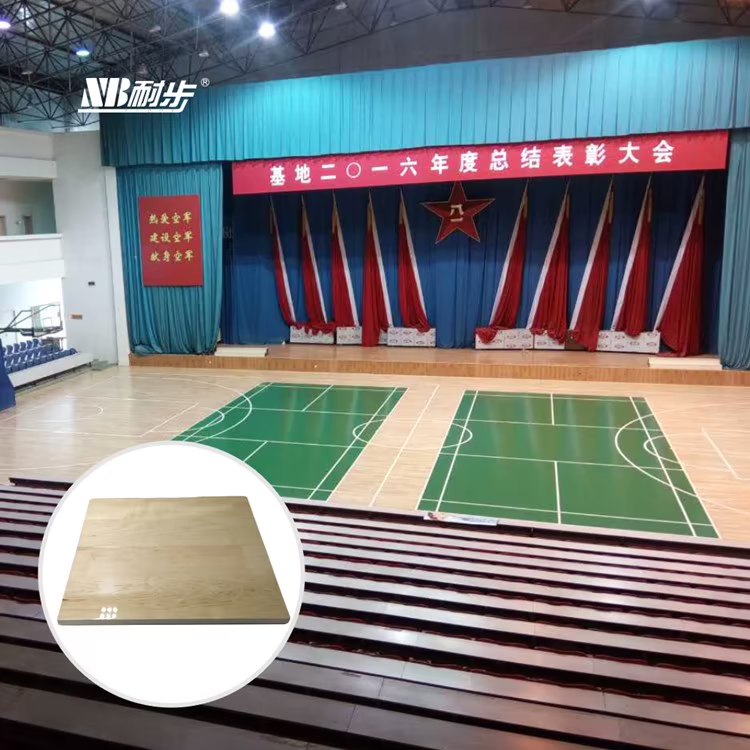
Because the system needs no permanent fixing, it can be laid over any flat, dry substrate — a hall floor, a concrete slab, a stage — and lifted away without damage to either surface. That no-fixing principle also protects your investment: the same panels serve a different venue configuration next season.
4. H500 and H600: Matching the System to the Duty Cycle
Within the modular hardwood category, the decisive question is duty cycle: how many times per year will the floor be assembled and removed, and how far will it travel? Our two portable systems are built around different answers.
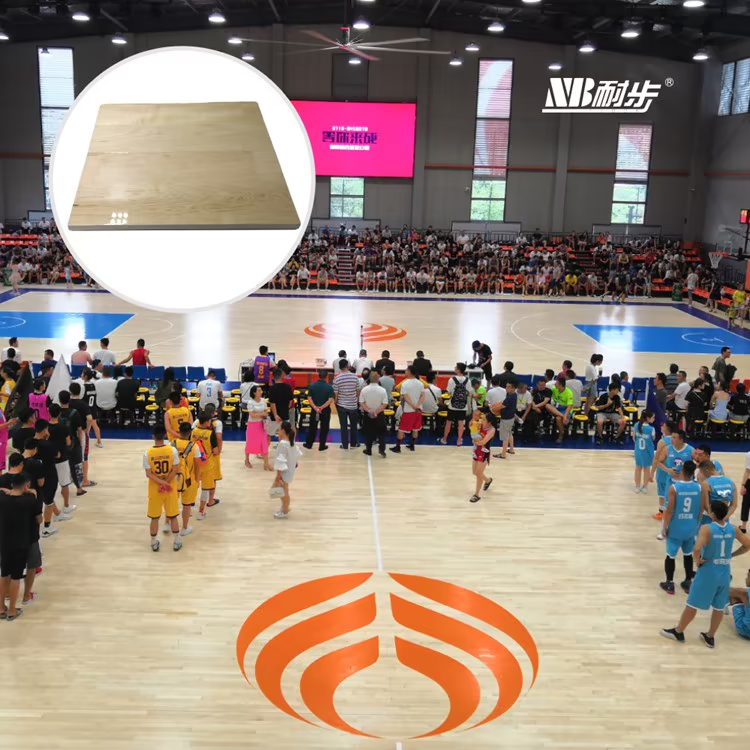
The H500 portable system is the general-purpose choice for temporary sports events, multi-purpose halls, and school gyms. It uses the 20 mm solid maple top board on the larch LVL batten and rubber cushion build-up, finished with a 95° high-gloss lacquer — the deep, reflective finish audiences associate with broadcast basketball. It carries Approved Equipment Level 1 certification (licence WF-05-01), the documentation level schools and federations ask for in tenders. With a crew of four to six, a standard basketball court assembles in approximately five hours — fast enough to convert a hall between a daytime school schedule and an evening event.
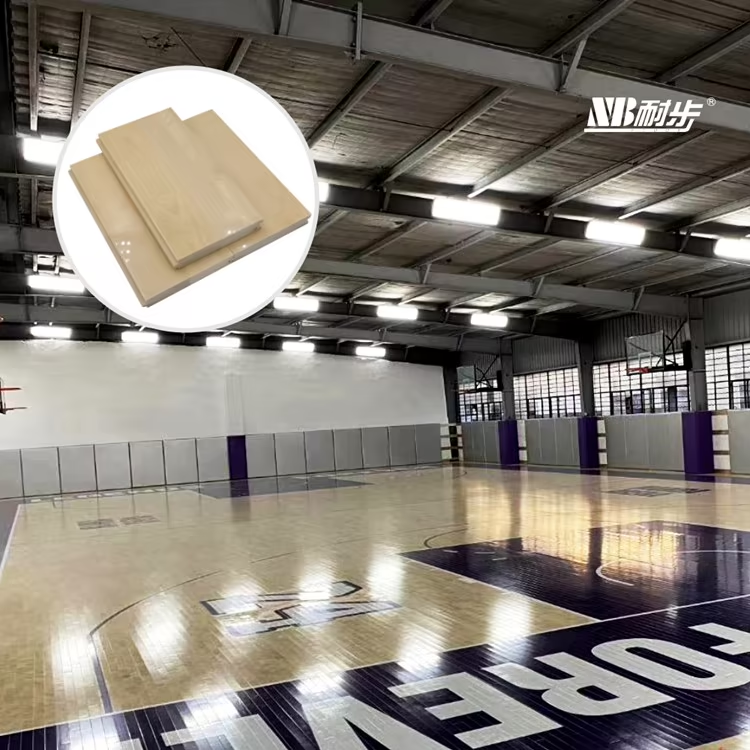
The H600 portable birch system shares the same structural build-up but uses a 22 mm solid birch top board, engineered specifically for frequent assembly and removal cycles — travelling courts, venues that reconfigure weekly, rental fleets. The thicker birch board tolerates the handling, edge loading, and transport vibration of a floor that lives more in trucks and storage than on display. It holds licence WF-05-02, also at Approved Equipment Level 1.
- Assembled fewer than roughly 10–15 times per year within one venue or region: the H500 maple system is typically the better value, with the classic maple look.
- Assembled dozens of times per year, moving between venues, or operated as rental inventory: the H600's heavier birch board is designed for exactly that duty.
- If the floor will rarely, if ever, move: a fixed system is almost always the better economic answer.
5. Fixed Systems, and the Substrate Nobody Checks Until It Is Too Late
Buyers sometimes ask for portable flooring because "portable" sounds flexible, when their actual program is a single hall used for basketball every day. In that case a fixed engineered floor delivers the same playing performance with lower cost per square meter, no assembly labor, and no storage footprint. Our fixed range covers this: the H3035 fixed system for standard installations, the H3035K high-load system where floors must carry seating, rigging, or mobile equipment, and the H3035M competition system for venues hosting genuine competition. Our overview of all sports flooring systems is the starting point for comparing the range.
Whichever category you choose, every installation assumes a substrate that is flat, dry, load-bearing, and clean — and skipping that check is the most common cause of first-year complaints we see.
- Flatness. The rubber cushion absorbs small irregularities, but a pronounced dip or crown shows up as a visible wave and creates bounce inconsistency exactly where games are decided. On stages or temporary platforms, verify decking is tight, level, and braced against flex.
- Moisture. Wood is hygroscopic. A slab with rising damp, or concrete that has not finished drying, will push moisture into the underside of the assembly. Test new slabs before installation.
- Load capacity and protection. The system's weight must be supported without noticeable deflection — and the substrate must be protected from the floor. A protective layer beneath the rubber prevents marking a host venue's surface, which matters when you install in a rented facility. Confirm it in writing before your first install.
- Cleanliness. Grit trapped under panels works into joints and accelerates edge wear. A ten-minute sweep before assembly is the cheapest maintenance the floor will ever get.
6. Performance Factors That Separate a Game Floor from a Practice Floor
When comparing quotations, move past species names and prices, and interrogate four properties. Ask every supplier to state them and to say how they were measured.
Shock absorption. An engineered build-up with a genuine resilient layer — batten cavity plus rubber cushion — absorbs a meaningful share of landing force; a hard surface returns nearly all of it. For a school gym used six hours a day, this is a safety feature, not a luxury. For an event floor, it is what players and coaches mean when they say a floor "feels right."
Ball bounce consistency. A basketball should rebound uniformly across the whole court, seams included. Connection design is the hidden variable: snake-spring connectors holding panels in continuous contact prevent the dead spots that occur at loose or mismatched joints. Walk any candidate floor and bounce a ball at every seam before you accept the installation.
Grip and gloss. The lacquered surface must provide traction for hard cuts without grabbing. This is a finish specification as much as a wood one — the 95° high-gloss lacquer on our portable systems is chosen not only for the arena look that photographs and broadcasts well, but because a properly cured sports lacquer delivers the friction profile basketball demands and can be maintained over the floor's life.
No brochure replaces your own acceptance check: define the properties that matter for your application, agree them in the contract, and verify them on the assembled floor before final payment. Our article on getting an accurate sports floor quotation explains how to structure specifications so quotes are genuinely comparable.
7. Logistics: Weight, Crew, Time, and Storage
For portable flooring, logistics are a large share of total cost of ownership. Answer these questions before you sign, not on the morning of your first event.
Panel weight and access. Solid-wood panels on battens with cushion layers are heavy by nature — intrinsic to hardwood performance. Confirm panel weight and dimensions, then confirm your venues can accept them: door widths, elevator capacity, dock access. Plan carrying routes before the truck arrives.
Crew and assembly time. The H500 assembles a standard basketball court in approximately five hours with four to six trained people. That is the honest benchmark for a mechanically connected hardwood system of professional quality — anyone promising a hardwood game court in two hours with two volunteers is selling something lighter, and it will play lighter too. Budget for crew training; the second assembly is dramatically faster than the first, and a practiced team is what makes repeated events profitable.
Storage and transport. Between events, panels and hardware must be stored flat, dry, and off concrete in a space with stable humidity. Measure your storage and confirm the packed system fits with access space — a floor stored badly is a floor you replace early. For travelling courts and rental fleets, ask how the system is packed for shipping: for importers, packing volume drives freight cost and can move the landed price meaningfully. Our article on how to install and store temporary sports flooring covers the handling discipline in detail.
8. Markings, Durability, and Lifecycle Cost
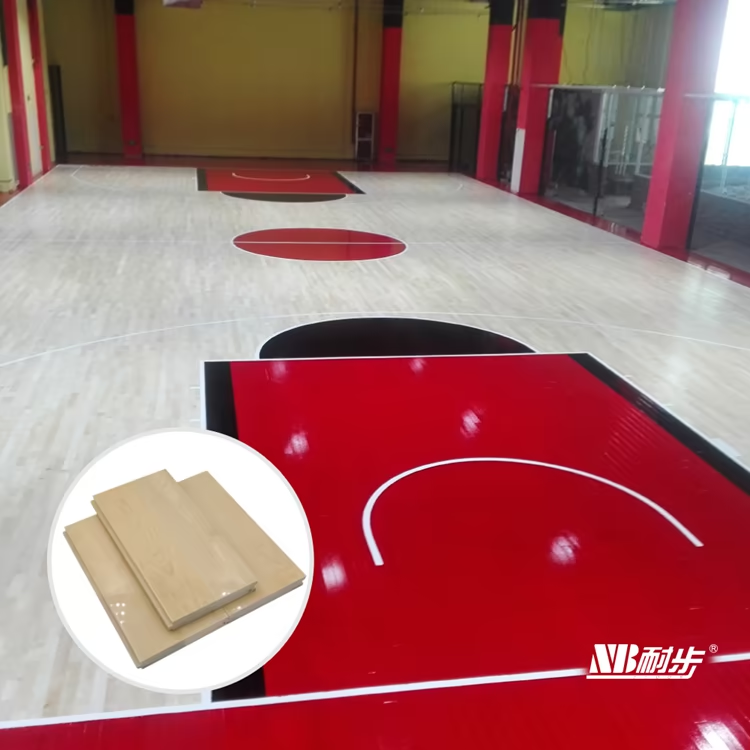
Markings. Court markings are applied to order on our systems — painted into the lacquer build during production, not taped on afterward. Specify your layout (FIBA standard, national federation dimensions, or school multi-court configurations) at quotation stage, because retrofitting lines later means refinishing work a properly specified floor never needs. If your hall hosts volleyball, badminton, or futsal as well, decide the full line package now — adding lines later is far more expensive. Center-court logos and sponsor branding are routinely produced for event floors, and for event companies a branded floor is a sellable feature, not a cost line. Ask every supplier how markings are produced: surface-applied markings will not survive repeated packing the way in-finish markings do.
Lifecycle cost. Purchase price is the smallest and most misleading number in this decision. Three components matter more. First, service life: a solid hardwood top board of 20–22 mm can be sanded and refinished multiple times over a long working life, while PP tiles and vinyl are replaced wholesale when worn — over a ten-year horizon, refinishing solid wood is dramatically cheaper than replacement. Second, maintenance: hardwood wants routine dry dusting and periodic care, an honest commitment we detail in our article on maintaining a wooden sports floor. Third, residual value — unique to portable systems and routinely ignored. A mechanically connected, no-fixing hardwood floor can be lifted, moved, and reinstalled elsewhere with most of its value intact; a glued-down fixed floor has none. For rental fleets and event companies, redeployability is often the strongest argument for the category.
Certification as commercial protection. Documented performance protects you in tenders, insurance discussions, and any incident review. Our portable systems carry Approved Equipment Level 1 approval — the H500 under licence WF-05-01, the H600 under licence WF-05-02. Treat any supplier who cannot produce equivalent documentation with caution, whatever their price. For budgeting context on the full project, see our breakdown of portable basketball court costs.
9. The Buyer's Checklist — and the Mistakes to Avoid
Work through this sequence before committing to any portable basketball floor.
The recurring mistakes we see are all avoidable with that checklist. Buying portability that will never be used is the most expensive one — if the floor stays put, a fixed system plays identically and costs less over life. Comparing systems by surface species and price alone hides the differences in batten design, cushion layer, and connection hardware where play quality actually lives. Underestimating assembly labor as a recurring cost, skipping the substrate survey, leaving markings until after delivery, storing panels on damp concrete, and accepting undocumented performance claims complete the list — small decisions at purchase time that become large costs later.
If your application is genuine repeated assembly and removal for basketball, our portable hardwood systems were built for exactly that duty: the H500 maple system for temporary events, multi-purpose halls, and school gyms, and the H600 birch system for frequent-assembly travelling courts and event venues. Send your duty cycle, venue list, and court layout via the contact form or WhatsApp, and our engineering team will respond with a specification-matched quotation within 48 hours.
Planning a sports floor project? Send the court dimensions, sports and destination port — we reply with a specification and a price within 48 hours.
Request a Quote